
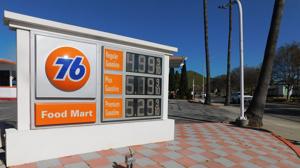
Gas prices have risen above $5 a gallon in California as the Southwest and the rest of America feel the impact of the U.S.-Israeli war with Iran.
The average at the Golden State’s pumps hit $5.16 a gallon Sunday and increased to $5.20 Monday, according to AAA. That’s an increase of 54 cents from the March 2 average of $4.66 a gallon in California, which consistently has had the most expensive gas in the U.S. for several years.
Similar increases were seen elsewhere in the Southwest. In Arizona, prices were up from $3.32 on March 2 to $3.86 on Monday. Colorado saw prices rise from $2.89 on March 2 to $3.41 on Monday. And Nevadans saw their gas average rise from $3.70 on March 2 to $4.21 on Monday.
California consistently has the nation’s highest prices, and the national average nearly passed the $3.50 per gallon average.
Gas prices, which largely reflect delayed oil prices, are expected to come down from a near 50-cent increase over the past week, if oil prices remain low in the coming days, according to AAA.
“Most of what we should think about right now is what oil’s doing today,” AAA Mountain West Group Spokesperson John Treanor told The Center Square Monday. The crude oil market peaked Sunday night over $118 and quickly came down overnight into Monday, according to OilPrice.com.
Gas prices, however, remained high in reaction to the sharp increase in oil prices from the war’s start on Feb. 28. The U.S. average gas price for a regular gallon was $3.48 Monday, up 48 cents from $3 last week, according to AAA.
The rapid increase of gas prices has impacted every state in the U.S., including in the Southwest where gas prices were already among the highest in the country.
The oil price dip Monday came after President Donald Trump said the war could end “very soon.” Later the same day, Trump said, “We will hit them so hard that it will not be possible for them or anybody else helping them to ever recover that section of the world,” according to media reports.
“For every dollar increase in crude oil, you can expect a 2- to 2.5-cent increase in the cost of gasoline at the pump,” Auto Club Group Spokesperson Skyler McKinley in Colorado told The Center Square. “And so I think it’s notable that [oil] prices have fallen since Friday, but we haven’t even priced those in yet on what we’re paying at the pump. We’re just now starting to probably price that swing in.”
McKinley added that while gas prices could be expected to come down in line with oil prices, it would be difficult to know how soon that might be, as the war continues to quickly change. As of Monday afternoon, the price of oil was at $87, its lowest since last week, according to OilPrices.com.
The U.S.-Israeli war with Iran quickly caused global oil and gas prices to rise, largely on speculation of a drawn-out war. Since the war began, Iran has attacked at least 10 vessels moving through the trade chokepoint that is the Strait of Hormuz. In 2024, around 20% of global petroleum liquids passed through the strait, according to the U.S. Energy Information Administration.
“The price swing we’ve seen in gasoline has been lesser at the start of this conflict than when Russia invaded Ukraine, when the national average jumped 60 cents in a seven day period,” said McKinley. He added later, “We’ve had expensive oil before. We’ve had expensive gas before. It is painful. It makes everything else in our economy more expensive, but I don’t hear a lot of folks talking about 2022 right now, despite it being the most expensive year on record, which shows you how short memories are with regard to some of these energy considerations.”
The average U.S. gallon of regular gas has not passed $3.50 since June 2024 and peaked over $5 in the summer of 2022, according to the U.S. EIA, after several months of Russia’s attack on Ukraine.
“The interesting thing is what are prices going to look like tomorrow?” said Treanor. “But this will show you how quickly things can swing.”