
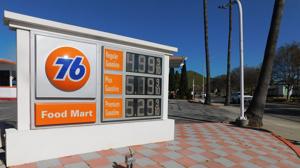
Republican legislators in California are concerned proposed changes to the state’s cap-and-trade program could drive up gas prices at least $1 a gallon.
The concern is being raised as California sees prices rise above $5 per gallon during the U.S. and Israeli war with Iran.
According to AAA, the national average across the country was $3.53 a gallon on Tuesday. In California, the statewide average was $5.29 a gallon, the highest in the country. The lowest per-gallon gas price on Tuesday was in Kansas, at an average of $2.96 a gallon.
Cap-and-trade, also known as cap-and-invest, is a state-run program in California that aims to reduce greenhouse gases, generate revenue to pay for clean energy projects and help communities affected by the effects of climate dangers, according to the Public Policy Institute of California.
A 2023 report from the nonpartisan Legislative Analyst’s Office states that California’s greenhouse gas reduction goals included reducing emissions to 1990 levels by 2020, 40% below the 1990 level by 2030 and 85% below the 1990 level by 2045. The timeline would essentially allow the state to attain carbon-neutral status in the next 19 years.
However, reducing greenhouse gas emissions requires fewer gas-powered cars on the road, according to the Union of Concerned Scientists, which cited research from the U.S. Environmental Protection Agency. Greenhouse gas emissions are caused heavily by transportation, the EPA data shows. Cars, trucks, ships, trains and planes burn more than 94% of petroleum-based fuels.
Carbon dioxide and nitrous oxides are the pollutants that go into the atmosphere, according to the EPA and lawmakers with knowledge of greenhouse gas emissions and the state’s cap-and-trade program.
“You weigh them [the pollutants], the molecular weight, and you pay so many dollars per ton for so-called cap-and-invest,” Assemblymember Stan Ellis, R-Bakersfield, told The Center Square on Tuesday. “When you continue to charge and escalate these prices, it does nothing but put an extra burden of cost on the manufacturer.”
Ellis said the costs are driving companies to close refineries in California.
“That’s why you see Valero leaving,” Ellis said about the company that has started to close its Bay Area refinery.
“You see Chevron writing letters, Marathon wrote a letter, PBF [Energy] wrote a letter – this is putting them out of business,” Ellis said about other companies that operate refineries in California.
According to a letter Chevron wrote to Gov. Gavin Newsom and the California Air Resources Board, the company opposes proposed limits to greenhouse gas reductions for local businesses across the state. Those changes to the cap-and-trade program could drive up the cost of gas in California an additional $1 a gallon, according to Assemblymember Greg Wallis, R-Rancho Mirage. Numbers proposed by the Assembly Republican Caucus put the increase at roughly an additional $1.21 a gallon by 2030, but Ellis fears it could be even higher.
“I predicted eight months ago it would go from $8 to $10 a gallon,” Ellis told The Center Square.
Another letter Chevron wrote to Newsom in 2024 urged the governor and other state officials to work with the oil and gas industry in California to help reduce the state’s rising gas prices.
That letter also pointed to the implementation of a proposed margin cap by the California Energy Commission as a tool that could drive up the cost of gas prices. That margin cap, which was authorized by the passage of 2023 bill Senate Bill 2, allowed the California Energy Commission to impose a gross gasoline refining margin, limiting the amount of gas that could be produced in the state.
That margin cap could also dissuade additional investment in gasoline supply and refining in California, Chevron wrote in that letter.
As cap-and-trade increases the cost of doing business in California, those who categorize the state’s program as restrictive are worried about not just the price of gas, but the impact on the state’s businesses and economy. Chevron estimated in the most recent letter to state officials that 536,770 jobs could be lost if this year’s proposals to change California’s cap-and-trade proposals are implemented, which in turn would affect $53 billion in annual labor income.
“Californians are already struggling with unaffordable gas,” said Wayne Winegarden, economist and senior business fellow at Pasadena-based Pacific Research Institute.
“We’re actually losing those jobs that get the economy going and create our prosperity,” Winegarden told The Center Square. “We’re losing those jobs, and we’re losing those businesses.”
The Center Square was not able to reach employees at the Western States Petroleum Association or GasBuddy. The Center Square was also unable to reach Democratic lawmakers with knowledge about greenhouse gas emissions and cap-and-trade on Tuesday.
AAA declined to comment for this story, but discussed the increase in gas prices in the Southwest with The Center Square in a story on Monday.